I’ve shared a few posts on Facebook about the recent flap over athletes peacefully making a statement during the playing of the national anthem by sitting or kneeling but I wanted to pull together some of my own thoughts on this topic as well.
I find it interesting how enraged some people are about a group of athletes exercising their Constitutional right to peacefully express themselves over an important issue that has garnered the ire of many. Isn't this one of the very rights over which our country has fought wars to protect?
We can't have it both ways, we either have freedom of speech or we don’t. Just as painful as it might be for someone to say or peacefully do something for which I disagree, it is my duty as a citizen of this country to protect and even celebrate their right to say it - it's in our constitution. If we want to quiet those with whom we disagree today, what is to stop those who disagree with us to turn those tables tomorrow? The few exceptions to this include speech that inflicts injury or incites violence and the definition of this type of speech has been (1) defined by the courts.
Until we’ve walked in the shoes of someone, we can’t know their journey, what they’ve been subjected to, witnessed or worse. To be an American is to embrace all that is good and bad about our country and then to attempt, in our own way, to move the needle toward that “more perfect union”.
I hope we can all agree there is way too much “us vs. them” in our country today. We’ve taken sides without considering that our point of view may not be perfect – might be skewed by the filters we’ve placed on our sources of information, our upbringing and our own life experiences. The only way we will move toward a more perfect union will be when we listen to one another, walk with, not against, those with whom we disagree and truly work to understand each other. This may sound a bit simplistic or even naïve but how else will we ever learn to live together if we don’t try.
In case you’ve not read it in a while, here’s Amendment I of the Constitution of the United States of America:
“Congress shall make no law respecting an establishment of religion, or prohibiting the free exercise thereof; or abridging the freedom of speech, or of the press; or the right of the people peaceably to assemble, and to petition the Government for a redress of grievances.”
1) Hate speech in the United States: https://en.wikipedia.org/wiki/Hate_speech_in_the_United_States
Monday, September 25, 2017

Thursday, March 5, 2015
Photography in the Snow - Avoiding Dull, Dark Photos.
 If you own a camera you are probably going to take photos of the winter wonderland outside.You may be shooting photos of kids playing in the snow, wildlife against the beautiful background of white or amazing landscapes. Regardless of what you're shooting, you'll want your photos to turn out great!
Here are some tips if you're using a DSLR or any camera that allows you to take creative control of the exposure. First, if you have the option, shoot in RAW. This will give you the best opportunity to correct any exposure problems once you've downloaded the files on your computer.
 Next and most importantly, you'll want to learn how to use the basics of your camera's histogram - a graphic display of the image your camera sees from the darkest to the lightest areas of the image. You can learn more about histograms following one of these links:
Canon - http://www.learn.usa.canon.com/resources/articles/2012/understanding_histograms.shtml
Nikon - http://www.nikonusa.com/en/Learn-And-Explore/Article/fvicbgac/learning-how-to-use-your-camera-s-histogram.html
If you have another make of camera, seach the web for your camera make and the word "histogram" (i.e. "sony histogram", "olympus histogram").
For this article I simply opened a window and took photos of our backyard, not for composition (obviously) just to show how a camera's meter can be fooled and how you compensate to get a great exposure.
For each example I've included the photos plus a copy of the unedited (right out of the camera) histogram so you can compare it to the results.
In fully automatic mode, most cameras will be confused by all of the light reflected off the snow and will result in underexposed photos.
Image: 1012
Mode: Fully Automatic
ISO 100
1/200 sec @ f9.0
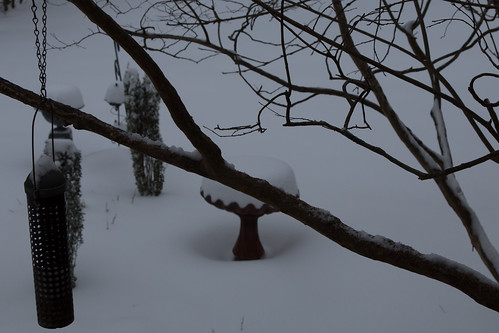
For my taste, this photo is 2 to 2-1/2 stops too dark.

So, what do you do? You have several options, your point and shoot camera may have a mode you can set for photos taken in bright conditions like snow or at the beach. If that's you're only option be sure to use that option. If you are shooting with a DSLR or other camera that gives you the option to switch to Aperture Priority (AV on Canon or A on a Nikon) use this mode but be prepared to make some Exposure Value (EV) adjustments to compensate for the camera meter's confusion about the bright snow by adjusting the exposure compensation to the plus side.
The best option is to switch to full Manual (M) mode and take total control of the exposure using your camera's histogram as your guide instead of relying on the camera's meter. Once you've been shooting in this mode a while you'll soon get a grasp of how to compensate for the light conditions without the need to look at the histogram for each photo. The final images in this article were shot in Manual mode.
But first, here are some examples taken in Aperture Priority mode and the resulting settings selected by the camera's meter plus my manual exposure value (EV) compensation settings.
Image: 1013
Mode: Aperture Priority
ISO 100
1/800 sec @ f/4.0
EV - 0
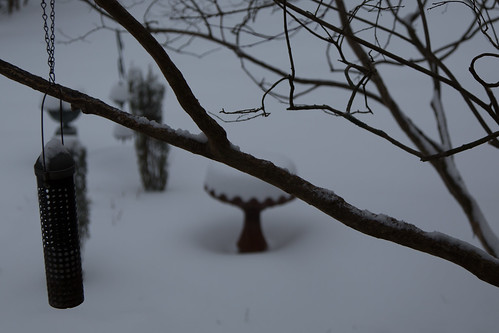

Basically, we're getting the same results as fully automatic,
very dark with little detail in the shadows and little color.
very dark with little detail in the shadows and little color.
Image: 1014
Mode: Aperture Priority
ISO 100
1/400 sec @ f/4.0
EV +1
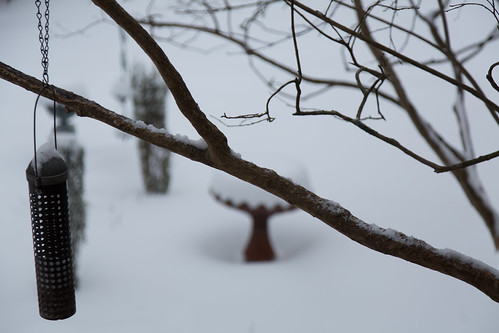

The additional +1 stop of EV certainly improves the exposure,
but the image is dull and we've still lost details in the shadows.
but the image is dull and we've still lost details in the shadows.
Image: 1015
Mode: Aperture Priority
ISO 100
1/160 sec @ f/4.0
EV - +2
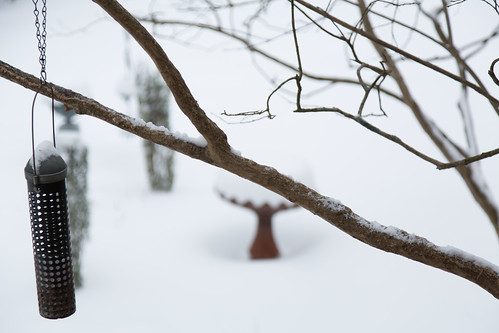

With +2 EV, the histogram is approaching the ideal for this type of photo. Lots of information
toward the right hand side of the graph without going too far and blowing out the highlights
(photo speak for over exposed in the lightest areas of the photo). Also, color and details in the
darker areas and shadows are beginning to appear.
toward the right hand side of the graph without going too far and blowing out the highlights
(photo speak for over exposed in the lightest areas of the photo). Also, color and details in the
darker areas and shadows are beginning to appear.
Image: 1016
Mode: Aperture Priority
ISO 100
1/80 sec @ f/4.0
EV - +3
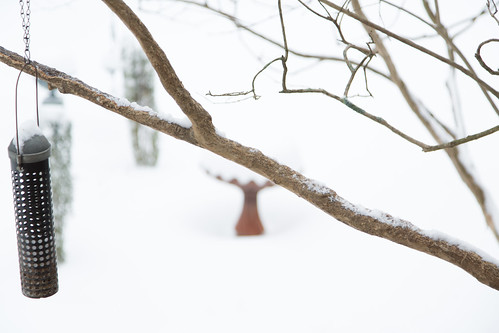

The histogram on this +3 EV exposure hasn't blown out the highlights but its getting close. Because it is a RAW file, we could probably recover some of the lost details in the brightest areas and we certainly have plenty of information to work with in the dark areas and shadows. Probably somewhere between +2 and +3 would be ideal using Aperture Priority for this image.
Image: 1018
Mode: Manual
ISO 100
1/125 @ f/4.0
EV - 0
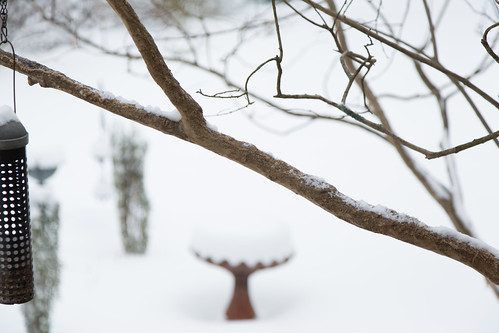
This image was exposed by simply using the histogram on the back of my camera's display.
The goal was to adjust the shutter speed only, keeping the lens at a constant f/4.0 aperture and the ISO at 100 to get the best possible image quality. Adjusting the shutter speed until the histogram was pushed to the right without being pushed all the way which would indicate blown out highlights, I was able to quickly grab this image.
Once the image above was downloaded, I used Lightroom 5.7 to add some "pop" to the image by increasing contrast, clarity, boosting shadows and some fine tuning to the tone curve. I also pushed vibrance and saturation a bit to enhance the colors against the white snow.
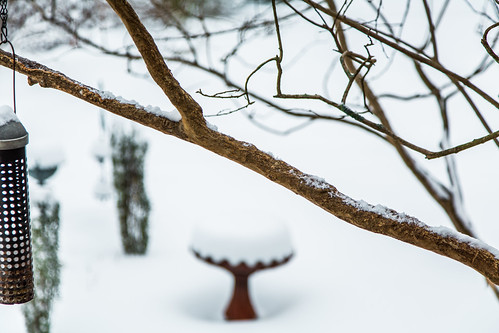
The edited version.
So, happy shooting and don't forget to stay warm! Keep your camera cold, your batteries warm and you'll get some great Snowmageddon 2015 shots!
Sunday, May 5, 2013
Adobe Lightroom Exercise
A little before and after comparison.
The bottom image on the right is one of four bracketed photographs taken in February 2012 at the Grand Canyon that were merged using the NIK HDR Efx Pro 2, Adobe Lightroom 4 (LR) plug-in. After the HDR composite was created in the plug-in, it was automatically added as a new TIF file in my LR library.
In LR, the image was further edited . Final touches of cropping, dust spot removal, selective sharpening to create an enhanced sense of depth, addition of grain, use of graduated filters to bring out the sky with saturation, exposure, contrast and clarity were all completed in LR. The finished image at the top is the result.
Finally, the finished before and after composite was created using Lightroom's Print module to create the JPG file you see in this article. Click on the image to view a larger version.
Regardless if you like this level of processing of a photograph or not, the point of the exercise was to see how far I could take a photograph from what the camera recorded to the image I saw in my mind without the use of Photoshop. Future versions of Lightroom will further expand the range of options available to photographers to create unique images based on what our minds see before and after the shutter button is pressed.
One interesting footnote is now that NIK software has been purchased by Google, will we see this technology added to the camera software built into Android phones? This could make for some interesting phone camera photo options.
Monday, April 15, 2013
Marriage Equality
The United States Constitution is both a frustrating and beautiful document that defines us and makes us a beacon for liberty around the world. David Badash, in his article entitled Constitution Day: Marriage Equality Is A Right The Constitution Demands said, “The U.S. Constitution is an elegant, elastic creation (yes, Tea Party, elastic,) that has guided and inspired us since it was signed into being over two centuries ago”.
Let’s not forget that our Constitution originally allowed slavery as well as race and gender discrimination. Fortunately, over time, we became more enlightened and basic human and civil rights became the law of the land.
The Supreme Court affirmed, in 1967, that marriage is, indeed, a civil right. In the unanimously-decided Loving v. Virginia, U.S. Supreme Court Chief Justice Earl Warren delivered the court’s opinion:
“Marriage is one of the ‘basic civil rights of man,’ fundamental to our very existence and survival.… To deny this fundamental freedom on so unsupportable a basis as the racial classifications embodied in these statutes, classifications so directly subversive of the principle of equality at the heart of theFourteenth Amendment, is surely to deprive all the State’s citizens of liberty without due process of law. The Fourteenth Amendment requires that the freedom of choice to marry not be restricted by invidious racial discrimination. Under our Constitution, the freedom to marry, or not marry, a person of another race resides with the individual and cannot be infringed by the State.”
Since 1967, marriage has been clearly seen by the court as a “civil right”. How can one not replace race with gender in this argument, especially in light of subsequent rulings of the Court.
The Fourteenth Amendment to the U.S. Constitution includes this passage: “…nor shall any State deprive any person of life, liberty, or property, without due process of law; nor deny to any person within its jurisdiction the equal protection of the laws.”
In Romer v. Evans, the Supreme Court case that ruled against a Colorado constitutional amendment that had prohibited state protections for homosexual citizens. And Lawrence v. Texas, which struck down sodomy laws in Texas, and, therefore, in the United States.
For me these references clearly show that our Constitution and laws, as defined by the courts, have long past determined that our Constitution provides and protects the rights given to any of us, to all of us. Anything less, threatens the basic foundation of our republic.
Extending the rights and freedoms most of us enjoy to everyone is not a weakness of our society but indeed at the very core of the strength of the fabric of our society.
There are those who choose to cling to the idea that the United States Constitution continues to defend selective forms of discrimination, violations of civil rights, limits to liberty or freedom. If the Constitution upholds any form of discrimination, then we are all at risk of losing our own freedoms.
While I often fall short of these standards there are concepts that serve as the foundation of my beliefs.
The Golden Rule provides the basis for much of my personal philosophy. In addition, Paul Harris, the founder of Rotary International, wrote and spoke extensively on tolerance, acceptance and equality being the very foundation for peace and goodwill in our world.
In my opinion, much of the strife in this world is caused by placing one’s positions, beliefs or status as separate from or above those of others. We will only find real and lasting peace among neighbors and nations when we wake to the realization that we are more alike than different, more equal than unequal.
Thursday, January 10, 2013
Topaz photoFXlab
I recently purchased the newest add-on for Photoshop and Lightroom (also works with Aperture and other photo editing software) and have started to get familiar with this very nifty way to use the Topaz Suite of photo editing filters.
Basically, photoFXlab pulls all of the Topaz filters you own under one interface, dresses them up a bit, adds some new features and presents you with a seemingly unending list of options to enhance your images. Here's an example of a before and after on a photo I shot last fall in our backyard.
Beyond the basic cloning and spot healing to address blemishes on the flower, the main work was digital enhancements using Topaz filters and "recipes" in photoFXlab.
Basically, photoFXlab pulls all of the Topaz filters you own under one interface, dresses them up a bit, adds some new features and presents you with a seemingly unending list of options to enhance your images. Here's an example of a before and after on a photo I shot last fall in our backyard.
 |
| Before |
 |
| After |
Wednesday, November 7, 2012
What now? How about real citizenship?
I've been watching Facebook this morning with equal parts of pride and sadness. Comments from both ends of the political spectrum are sprinkled throughout my news feed. Chicken Little says the sky is falling, America is toast, voters are stupid, we are saved and all of our problems are now solved. Some who voted for the loser are pragmatic and ready to move on. Well, here's my challenge regardless of which way you voted.
Stop whining or gloating (depending on how you voted), this
is not citizenship; in fact it is just the opposite!
Instead, start by resolving to take Governor Romney's and
President Obama's messages from their speeches last night and turn them into
action. (Links to both speeches are included
below.)
Here's a plan. Watch
and listen to every elected official’s words and deeds to make sure they are
working as hard as they can to forge compromise and build real solutions to our
problems. Start with your city council and go right up the ladder to the State House, the U.S. Congress and the Oval Office. Make sure each one is focusing
their work on the country and not their party or special interest group. Look for and call them out when they build
walls instead of bridges, tell them to stop it when hate speech, scare tactics,
name calling or demonization are used instead of negotiation and working
together.
Don't depend on a single source of news for your information;
search out multiple sources; don't allow some highly paid commentator's opinion or some blowhard's ideas (like me?)
to become yours. Make up your own mind, listen to people you don't agree with
and try to understand their views and the reasons for them.
What happens now is not up to those who were elected; it is
up to each of us to make sure our country moves forward and our elected leaders
put country, not party or the next election first. If they fail, that's
what elections are for.
I've selected just a few paragraphs from last night's speeches that
begin to set the tone we should all seek.
From Governor Romney's speech:
"The nation, as you know, is at a critical point. At a
time like this we can't risk partisan bickering and political posturing. Our
leaders have to reach across the aisle to do the people's work, and we citizens
also have to rise to occasion. We look to our teachers and professors. We count
on you not just to teach, but to inspire our children with a passion for
learning and discovery. We look to our pastors and priests and rabbis and
counselors of all kinds to testify of the enduring principles upon which our
society is built: Honesty, charity, integrity, and family. We look to our
parents. From the final analysis, everything depends on the success of our
homes. We look to job-creators of all kinds. We're counting on you to invest,
to hire, to step forward, and we look to Democrats and Republicans in
government at all levels to put the people before the politics."
From President Obama's speech:
"I want to thank every American who participated in
this election, whether you voted for the very first time or waited in line for
a very long time. ... Whether you pounded the pavement or picked up the phone,
whether you held an Obama sign or a Romney sign, you made your voice heard and
you made a difference.
...we will disagree, sometimes fiercely, about how to get
there. As it has for more than two centuries, progress will come in fits and
starts. It's not always a straight line. It's not always a smooth path. By
itself, the recognition that we have common hopes and dreams won't end all the
gridlock or solve all our problems or substitute for the painstaking work of
building consensus and making the difficult compromises needed to move this
country forward. But that common bond is where we must begin.
... You
elected us to focus on your jobs, not ours. And in the coming weeks and months,
I am looking forward to reaching out and working with leaders of both parties
to meet the challenges we can only solve together. ... We've got more work to
do."
President Obama's Election Night Speech:
Governor Mitt Romney's Concession Speech:
I hope you read the speeches, keep them around and follow what happens next.
Friday, October 12, 2012
Sequoia High Sierra Camp Night Sky Photography
 |
| Gearhart View II September 11, 2012 |
I shot this with a Canon EOS 5D Mark II camera and a Canon EF 16-35mm f/2.8L II USM lens at 16 mm. The camera was set to ISO 3200, f/2.8 with a 30 second exposure. Focus is a challenge so switching to manual focus using live view, I attempted to focus on a very bright star near the center of the frame. The single image was processed in Lightroom 4.2. The trees were illuminated by a combination of a few solar powered lamps on the ground, a gas lantern in our tent and my head lamp used to "paint" the trees.
Today's digital cameras make this type of photography easier but it still requires understanding some basic rules of the art and science of shooting the night sky. It's a process of continuous learning and experimentation.
Many thanks to professional photographer, Jennifer Wu who tried to teach a class room full of Canon Live Learning EOS Destination Workshop attendees how to photograph the night sky one rainy weekend in Yosemite a couple of years ago. What she taught, at least in theory, got me seriously interested in this type of photography. Throw in hours of Google searches and YouTube tutorials and there is no shortage of ideas and inspiration.
The teacher in me likes to share what I'm learning on this journey but I have a very long way to go before I achieve the results of some of the pros who inspire me.
Happy shooting!
Saturday, July 14, 2012
Bumblebee Hawkmoth
My wife spotted this critter working the flowers in her mom's backyard this afternoon. I happened to have a camera so we watched and photographed him for several minutes . Here are two shots of the Bumblebee Hawkmoth. This large moth was new to us but a friend helped us identify him.
 | |
 |
| Bumblebee Hawkmoth |
Sunday, June 17, 2012
My Dad and His Values
 My Dad was an interesting and complex guy. We were business partners for nearly four decades but not best buds. He was my boss for the first 20 years and as his health declined he became a valued advisor. He was there when I needed him but we didn’t do a lot of father - son stuff together. As part of the Greatest Generation, he worked to take care of his family and to take care of his business. He worked because that was who he was.
He deeply cared for people - his family and his friends. He was independent and he really loved my mother, some might say to a fault, but maybe that’s a definition of love. While his kids didn’t see it often, he had a fun side; he loved a good time, had a sense of humor and loved kidding people.
He cared about young people – he was a Key Club Sponsor in his earlier days and later in life he served on the board of City Youth. He also loved Jonesboro and cared deeply about the opportunities the community made for others. His service on various boards and commissions was one of the things that kept him going, long after his health began to fail.
One of the last major initiatives that he unfortunately missed come to fruition before he passed away was the Jonesboro Economical Transportation System (JETS) public transit system. He clearly understood that public transportation would open new doors of opportunity to our citizens, especially those with the greatest needs.
He believed in fairness, he wanted to give people a chance. If someone let him down, he’d give them another chance and then another. He was not greedy; he was generous with his time and his money. He understood the idea of service to others, not because of what he received in return but simply because it was important to give back, a sort of social payment for the opportunities he’d been given.
As I think about my Dad and the current political debates, especially the core debates about who we are as a people and the role of government in our society, I know he would be disturbed. Dad was a lifelong Democrat and truly believed in the principles of Roosevelt’s New Deal, Kennedy’s and Johnson’s vision of the American dream for all and Clinton’s understanding that we are our brother’s keeper and protecting the most vulnerable in our society is part of government’s role. Dad was a patriot who fought for our country in World War II and believed in all that America stands for.
He would be concerned about policies that favor the rich and powerful at the expense of the poor and middle class. He would support those who fight for fairness and accountability. These are the same values he practiced in his life and in our business. He treated employees and customers like family. He’d lay awake at night worrying about them and taking action to make things better and right when he could.
I feel certain that if he can, Dad is sending messages to his friends who’ve not joined him yet and he’s encouraging them to do what's right and best for our nation and her values in which he believed, lived and went to war to protect.
Happy Father’s Day Dad and thanks!
Saturday, June 16, 2012
Cookies and Cream

Today, while grocery shopping, we discovered the exceptionally intelligent marketing geniuses at Breyers have merged two of my favorites into Breyer’s Golden Oreo Cookies and Cream. Life just got a little sweeter!
But wait, there’s more! Breyers is a Unilever brand and they own and operate a hair care products plant here in Jonesboro. So follow me on this, I am considering a campaign to get them to add Breyer’s Golden Oreo Cookies and Cream to their product line made here so we can shop in their outlet store. That way, when they mess up a batch and put in too many Golden Oreo Cookies, instead of scrapping the lot as a quality control failure, they can just sell it in the outlet store. I’m hoping they have an outlet store, it not, that may need to be part of my campaign too.
If you'd like to join me in this campaign, just let me know.
Thursday, June 14, 2012
Fine Art Photography and Digital Painting
 |
| Multnomah Falls, Columbia River Gorge, Oregon Canon 5D Mark II, 16-35mm f/2.8 II lens 1/25 sec f/4.0, ISO 100, 21 mm |
The artistic process can follow a variety of paths. The path my classmates and I followed that week was great fun. I learned more than my brain could hold and gained new skills that make my time shooting and processing photos a lot more fun. Everyone in the class was there to learn from our instructors and each other. My classmates were generous with their encouragement and unselfish sharing of expertise and advice. The class has inspired me to not only get out and shoot more but I've been digging through my library of images applying what I learned to turn them into entirely new and interesting works.
In 2009 Marilyn and I spent some time in Oregon's Columbia River Gorge including the often photographed Multnomah Falls. Today I revisited one of my photographs of this iconic waterfall, applied some of the skills and techniques learned during the class and produced the image included with this post. You can click on the image to view a larger version.
Learning is a life-long adventure! It keeps the brain and soul nourished as well as open to new ideas and adventures. I wonder what's next?
f16iso100
Why is the address of my blog "f16iso100"?
 |
| Grand Canyon ISO 100, f/16, 0.5 sec |
F-Stop - Relative Aperture most commonly referred to as "F-Stop" refers to the size of the opening in relationship to the focal length of the camera lens through which light travels on its way to the sensor or film. f/16 represents a smaller relative opening (the larger the number the smaller the opening - f/2.8 is a much larger opening than f/22). In most lenses, this results in a large depth of field (DOF) so both foreground and background objects appear in focus (as with any rule, there are exceptions - macro photography is one of these so a post on macro photography seems likely). A comprehensive article about aperture can be found here: http://en.wikipedia.org/wiki/F_stop
ISO 100 - refers to film speed or for digital cameras, the sensor's sensitivity to light. The lower the number the less sensitive to light. Referred to as "slow" film, this low sensitivity to light setting in digital cameras or film speed can result in higher quality images due to less "grain" or noise in the final images. This ISO setting / film speed is often used when there's ample light or it's possible to leave the shutter open longer to allow enough light to reach the film or sensor for a proper exposure.
Higher and Higher ISO's - One interesting development of the past few years in digital camera evolution is the very high ISO settings possible that can create stunning low light photography. The major digital camera manufacturers such as Canon, Nikon, Sony and others are constantly pushing the limits on this technology. Today, ISO settings in the four and five figures and beyond are pushing photographers to rethink available light photography. (I think this will be a good topic of a future post).
I am certainly no expert on ISO so here's a link to an article that will help you better understand film speed: http://en.wikipedia.org/wiki/Film_speed
A passing thought about f/16 and ISO 100. With a small aperture, objects, both near and far can be sharp and in focus and an ISO setting of 100 helps create a higher image quality. Not a bad philosophy for work and life! Keep things in focus, both the issues up close that have our attention today and those out there near the horizon that may be more important tomorrow while, at the same time, do things in a manner that creates the best chance for a high quality outcome. (No, I'm not writing a self help book, I just like the analogy.)
What's your favorite camera setting and why? What are your thoughts on ISO, Aperture, Shutter Speed or anything else for that matter. Do you prefer full manual control or do you find full Auto or Program modes to be your cup of tea? Use the comment area below to send me your thoughts.
Welcome
Welcome to - Through My Lens. I have no idea where this will go, but I've been thinking about creating a blog for some time and today just seemed like the day to begin. So, here goes!
I decided on the name "Through My Lens" for obvious reasons. If you know me, you know I often have a camera around my neck and enjoy photography's many aspects. I'm a geek so anything that deals with technology is just down right fun for me. Photography also gives me pleasure when I see someone relate to something I've done - either a beautiful photograph right out of the camera or an enhanced image from my digital darkroom.
I admire the work of some well known and not so well known photographers. I get a great deal of inspiration from them so you will probably see me highlighting other photographers' work in my posts.
Topics other than photography may appear from time to time. The "lens" metaphor will serve as a guide for choosing topics I find interesting.
Finally, you may have noticed the URL of my blog begins with "f16iso100". Photographers will recognize this but may still wonder why I chose this for my blog. More on that next...
Thanks for "looking in".
 |
| Photo by Tim Rand |
I admire the work of some well known and not so well known photographers. I get a great deal of inspiration from them so you will probably see me highlighting other photographers' work in my posts.
Topics other than photography may appear from time to time. The "lens" metaphor will serve as a guide for choosing topics I find interesting.
Finally, you may have noticed the URL of my blog begins with "f16iso100". Photographers will recognize this but may still wonder why I chose this for my blog. More on that next...
Thanks for "looking in".
Subscribe to:
Posts (Atom)